
If you have ever caught your tooth on a fork tine, taken an elbow during a basketball game at the Great Park Sports Complex, or bitten into a bagel and felt something snap, you already know how a chipped tooth happens. What you might not know is why your tooth chipped in the first place, what classification a dentist would give the damage, and which repair option fits your specific situation. This article covers all of that, with a focus on what Irvine residents actually need to know to make a confident decision about their care.
If you are dealing with a fresh chip and need step-by-step first aid right now, our companion article on what to do immediately after chipping a tooth walks through the first hour. This piece zooms out and covers the bigger picture: why chips happen, how dentists assess the damage, what your repair options look like compared side by side, and how to choose a dentist in Irvine for the work.
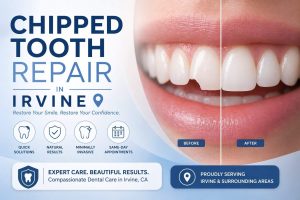
Why Chipped Teeth Happen More Often Than You Think
Tooth fractures are one of the most common dental injuries, full stop. According to a StatPearls reference on tooth fracture indexed by the National Library of Medicine, the prevalence of tooth fractures ranges from 6.1% to 58.6% in permanent teeth depending on the population studied. More than 75% of those fractures involve the upper jaw, with the central incisors (your two front teeth) being the most commonly affected because of where they sit in your mouth.
The causes are not surprising once you see them all in one place: sports impacts, falls, vehicle accidents, biting on something hard, grinding, and using your teeth as tools. But within those broad categories, the patterns are worth knowing because they help you understand your own risk.
Sports and Recreation
Irvine is one of the most active cities in the country, with the Great Park Sports Complex, Great Park Ice, Mason Regional Park, miles of mountain biking trails through the foothills, and youth leagues for every sport you can name. That activity comes with a cost dentists see every week. A PMC review on common dental injury management in athletes reports that the upper lip, maxilla, and central maxillary incisors are involved in up to 90% of all orofacial and dental trauma, and that the majority of dental injuries are tooth crown fractures, avulsions, or subluxations.
Basketball, soccer, hockey, baseball, mountain biking, and martial arts all carry meaningful risk. A retrospective study published in the Journal of Pharmacy and Bioallied Sciences found that contact sports like football (40%) and basketball (30%) were the leading contributors to sports-related dental trauma, with tooth fractures making up half of all injuries. The same study found that immediate intervention within thirty minutes resulted in an 80% success rate, while delayed treatment dropped that figure to 50%.
The takeaway is not that you should stop playing sports. It is that a properly fitted mouthguard, especially for basketball, hockey, soccer, and any martial art, dramatically reduces your risk.
Bruxism (Tooth Grinding)
Many adults grind their teeth in their sleep without realizing it. Over months and years, the repeated stress thins the enamel and creates microscopic cracks that eventually give way during normal eating. Bruxism as a major cause of tooth chips and cracks. If you wake up with a sore jaw, headaches near your temples, or you have a partner who reports grinding sounds at night, get evaluated. A custom nightguard is one of the best investments you can make against future chips.
Hard Foods and Bad Habits
Ice, hard candy, popcorn kernels, olive pits, raw nuts in the shell, and crusty bread are all common culprits. So is using your teeth to open packaging, snip thread, or hold things while your hands are busy. A surprising number of chips happen from completely ordinary bites because the tooth was already weakened by a large filling, an undiagnosed crack, or thinned enamel from acid exposure.
Acid Erosion
Chronic acid exposure thins enamel, making chips much more likely. The most common sources are GERD (acid reflux), frequent vomiting, sucking on lemons or other acidic foods, sipping soda or sports drinks throughout the day, and sometimes acidic medications. GERD can break down enamel over time, and that this thinning increases your risk of chipping even with normal use of your teeth.
Age and Existing Dental Work
Enamel naturally weakens with age. You are more likely to chip your teeth if you are over fifty, and that previous major dental work (especially large fillings) leaves your teeth less structurally sound than they were originally. None of this means an older or restored tooth will inevitably chip, but it does mean those teeth deserve a little more caution around hard foods.
Concerned about your risk of chipping a tooth? An evaluation can spot weak spots before they break.
How Dentists Classify Chipped Teeth
When you walk into a dental office with a chipped tooth, the dentist is mentally running through a classification system to figure out how serious the damage is and what repair will work best. The most widely used framework is the Ellis classification, originally proposed by Ellis and Davey in 1970 and still taught in dental and emergency medicine programs today.
The three most relevant Ellis classes for a chipped front tooth are:
Ellis Class I: A fracture involving only the enamel. The tooth has no color change and typically no pain, since enamel itself has no nerves. This is the most common kind of chip, and treatment is usually cosmetic only (smoothing or small bonding).
Ellis Class II: A fracture involving the enamel and the dentin underneath. The chip exposes a yellow or ivory-colored layer that is sensitive to hot, cold, air, and touch. Because dentin is porous and connects to the pulp through tiny tubules, Ellis II fractures need a sealed restoration to prevent bacteria from working their way down toward the nerve.
Ellis Class III: A fracture extending into the pulp, the soft tissue at the center of the tooth that contains the nerve and blood supply. A telltale sign is a pink or red dot at the center of the fracture surface, sometimes with bleeding from the tooth itself. Ellis III fractures are painful, time-sensitive, and almost always require root canal treatment followed by a crown.
You do not need to memorize this. The point is that when your dentist looks at your chipped tooth, they are not guessing. They are placing it on a clinical spectrum that has decades of treatment evidence behind it, and the class determines almost everything about the recommended repair.
Comparing Your Treatment Options Side by Side
Our companion article on what to do after chipping a tooth walks through each treatment narratively for someone deciding what to expect at their appointment. This section is for the comparison shopper who wants to weigh options across consistent dimensions before they pick up the phone.
Once the dentist classifies the chip, they will walk you through your options. Here is how the most common treatments compare across the dimensions that matter most to patients.
Smoothing and Polishing (Enameloplasty)
Best for: Tiny Ellis Class I chips that are only cosmetic concerns. Time: Usually under fifteen minutes. Anesthesia: Typically none needed. Reversibility: The natural tooth is permanently reshaped, but only by a tiny amount. Lifespan: Permanent, since no material is added. Drawback: Cannot fix anything more than a very minor edge.
Dental Bonding
Best for: Small to medium Ellis Class I and II chips, especially on front teeth. Time: About thirty to sixty minutes per tooth, completed in one visit. Anesthesia: Usually none required. Reversibility: Mostly reversible since little or no enamel is removed. Lifespan: Bonding lasts between three and ten years before needing a touch-up. Drawback: Less durable than porcelain options and can stain over time with coffee, tea, or red wine.
Fragment Reattachment
Best for: Patients who saved the broken piece and brought it to the appointment in milk or saline. Time: About thirty to sixty minutes. Anesthesia: Usually minimal. Reversibility: The fragment is bonded back, no enamel removed. Lifespan: Variable, but a comprehensive PMC review on fragment reattachment confirms that with modern adhesive systems, reattachment is now the treatment of choice when a viable fragment is available because of the perfect color and texture match. Drawback: Requires the original fragment in good condition.
Porcelain Veneer
Best for: Larger Ellis Class I and II chips on front teeth, multiple chips on the same tooth, or cases where the patient also wants to address staining or shape simultaneously. Time: Two visits, usually a couple of weeks apart. Anesthesia: Local anesthesia for the prep visit. Reversibility: Not reversible, since a thin layer of enamel is removed. Veneers typically last ten to fifteen years with proper care. Drawback: More expensive than bonding and requires removing healthy enamel.
Dental Filling
Best for: Chips on back teeth (molars and premolars) where chewing pressure makes bonding less reliable, or Ellis Class II chips that need a sealed restoration to protect the dentin. Time: One visit. Anesthesia: Local anesthesia depending on depth. Reversibility: Not fully reversible, but the procedure is conservative. Lifespan: Varies by material, often comparable to bonding for composite fillings.
Dental Crown
Best for: Large chips, chips that extend below the gumline, teeth weakened by major existing fillings, or any tooth treated with a root canal. Time: Two visits in most cases, or a single visit if your dentist offers same-day porcelain crowns. Anesthesia: Local anesthesia. Reversibility: Not reversible, since the tooth is reshaped to fit the crown. Crowns last between five and fifteen years with proper care, with material choice influencing both durability and appearance.
Root Canal Plus Crown
Best for: Ellis Class III fractures where the pulp is exposed or infected, or any chipped tooth with severe ongoing pain and temperature sensitivity. Time: One or two visits for the root canal, then additional visits for the crown. Anesthesia: Local anesthesia. Reversibility: Not reversible. Lifespan: A successful root canal can preserve the tooth for many years (often decades) when properly maintained, with the crown protecting it from fracture.
You can read more about how we approach restorative cases on our cosmetic dentistry page, and our root canal page covers what to expect if your chip turns out to involve the pulp.
Want a clear recommendation tailored to your specific chip? Dr. Chien will walk you through every option in plain language.
First Steps After You Notice a Chip
The decisions you make in the first hour after a chip influence what your repair will look like. The short version: rinse with warm water, save the fragment in milk if you have it, apply a cold compress for swelling, take ibuprofen if you can, cover any sharp edge with dental wax or sugar-free gum, and call a dentist. We cover each of these steps in detail in our companion article on what to do after chipping a tooth, including when a chip qualifies as a true dental emergency that needs same-day care.
For Irvine residents who want a quick reference: if you can see pink or red tissue inside the tooth, if the pain is severe and not responding to ibuprofen, if bleeding does not stop after ten to fifteen minutes, or if the chip happened along with any blow to the face or head, treat it as urgent and get seen the same day.
What to Look For in an Irvine Dentist for Chipped Tooth Repair
Not every dentist approaches chipped tooth repair the same way. Here are five things worth checking when you are choosing where to go:
Conservative philosophy. A good dentist for chip repair will recommend the least invasive option that solves your problem, not the most profitable one. If you have a small Class I chip and you are being pushed toward a veneer or crown without a clear reason, get a second opinion.
Same-day capability. For larger chips that need a crown, same-day porcelain crown technology lets the dentist scan, design, mill, and place the crown in a single visit instead of making you come back twice with a temporary in between.
Cosmetic experience on front teeth. Bonding and veneers on front teeth are partly a science and partly an art. The shape, translucency, and shade matching all depend on the dentist’s eye and experience. Ask how many bonding and veneer cases the dentist personally handles each month.
Same practice for follow-up care. Bonding and crowns occasionally need adjustment as your bite settles. You want the same practice handling the placement and the follow-up so nothing gets lost in translation.
Honest pricing conversation upfront. Before any work starts, you should know what is covered by your insurance, what is not, and what the realistic out-of-pocket range looks like. We always walk patients through this before scheduling treatment.
If you want to learn more about our practice, our home page covers Dr. Stan Chien’s background and the full range of services we offer in Irvine.
Frequently Asked Questions About Chipped Tooth Repair
How much does chipped tooth repair cost in Irvine?
Cost varies widely based on the type of repair, the size and location of the chip, the materials used, and your dental insurance coverage. Bonding is typically the most affordable option, fillings and smoothing fall in the middle range, veneers and crowns are higher, and root canal plus crown is the most extensive investment. We can give you a specific estimate after an exam and X-rays, and we always go over the numbers with you before any treatment starts.
Should I see a general dentist or a specialist for a chipped tooth?
For most chips, a general dentist with cosmetic and restorative experience is your best first stop. They can handle smoothing, bonding, fillings, veneers, and crowns in-house. You may be referred to an endodontist if a root canal is needed and your general dentist does not perform them, or to an oral surgeon in the rare case where extraction and implant placement are required. Starting with a general dentist saves you a step in most cases.
How long does chipped tooth repair take?
Smoothing takes under fifteen minutes. Bonding and fragment reattachment usually run thirty to sixty minutes per tooth in a single visit. Fillings are similar. Traditional crowns require two visits over a couple of weeks (with a temporary crown in between), or a single visit if the practice offers same-day porcelain crowns. Root canals typically require one or two visits, plus the additional visits for the crown.
Can a chipped tooth get worse if I leave it alone?
Yes. Even minor chips warrant a dental visit because only a provider can assess whether damage extends beyond the enamel. Once the enamel barrier is broken, the softer dentin underneath is exposed to bacteria and decays much faster. A chipped tooth is also structurally weaker, so the same bite that caused the chip can cause the rest of the tooth to fracture further. Waiting often turns a thirty-minute bonding visit into a multi-visit treatment.
How do I know if my chipped tooth needs a root canal?
The clearest sign is severe, lingering pain, especially pain that gets worse with hot or cold and lasts for more than a few seconds after the trigger goes away. A visible pink or red dot at the center of the chip is another strong indicator that the pulp is exposed. Throbbing pain that wakes you up, swelling near the tooth, or pain when biting down can also point to pulp involvement. Only an exam and X-rays can confirm, but if you have any of these symptoms, get seen quickly.
Are there any home remedies for a chipped tooth?
No. There is no home remedy that restores tooth structure or stops bacterial progression once the enamel is broken. Dental wax and over-the-counter temporary repair kits can protect a sharp edge for a few days until you reach a dentist, but they are bridges to professional care, not substitutes. Oil pulling, salt rinses, and other home treatments do not bond enamel or seal exposed dentin.
Schedule Your Chipped Tooth Evaluation in Irvine
If you have a chipped tooth and want it evaluated by a dentist who has been practicing in Irvine for decades, we are happy to help. Dr. Stan Chien and our team handle chipped tooth repairs every week, from quick polish-and-smooth visits for small Ellis Class I chips to full crown rebuilds and root canals for more serious cases. We will walk you through every option that makes sense for your specific situation before any work starts.
Call us at (949) 379-8010 to schedule an evaluation, or visit our contact page for more options.
The sooner we look at your chip, the more options you’ll have. Reach out today.
This article is for informational purposes only and does not constitute medical advice. Always follow your dentist’s specific post-operative instructions, as individual care recommendations may vary based on your unique situation.

