
A dental crown might not be on your radar until your dentist brings it up. But the truth is, your teeth often send clear warning signals long before they reach the point of no return. The problem? Most people either don’t recognize those signals or assume the discomfort will go away on its own.
Crowns are one of the most common restorative treatments in dentistry for good reason. A study published in the Journal of the American Dental Association found that practitioners most frequently recommend crowns for teeth that are fractured, cracked, endodontically treated, or have broken restorations. That means there are specific, identifiable situations where a crown becomes the best path forward for saving a tooth.
If you’ve recently had a dental crown procedure and want to understand what led to it, or if you’re wondering whether something going on in your mouth might warrant one, this guide will walk you through the most common signs that a dental crown could be in your future.
What Exactly Is a Dental Crown?
Before diving into the warning signs, it helps to understand what a crown actually does. A dental crown is a custom-made cap that fits over the entire visible portion of a tooth above the gumline. The American Dental Association describes it as a restoration used to strengthen teeth weakened by large fillings or dental treatments like root canals.
Think of it as a protective shell. When a tooth has lost enough structure that a filling can no longer do its job reliably, a crown steps in to hold everything together, restore your ability to chew normally, and prevent the tooth from breaking further. Crowns can be made from porcelain, ceramic, zirconia, metal alloys, or a combination of these materials, and modern options are designed to look and feel like your natural teeth.
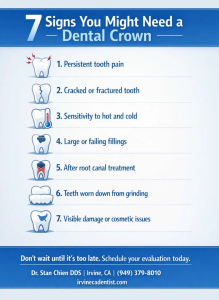
Persistent Tooth Pain That Won’t Go Away
One of the most common reasons people end up needing a crown is tooth pain that lingers. This isn’t the fleeting twinge you get from biting into something cold. It’s the kind of pain that shows up repeatedly, whether you’re eating, drinking, or sometimes doing nothing at all.
Persistent toothaches can signal several underlying problems. The tooth may have deep decay that has reached or is approaching the nerve. There may be a crack or fracture in the tooth that isn’t visible to the naked eye. Or a previous restoration, like an old filling, may be failing and allowing bacteria to reach deeper layers of the tooth.
When decay progresses far enough, a standard filling often can’t provide adequate protection. Clinical guidelines from Delta Dental state that a crown is indicated when 50% or more of the coronal tooth structure is missing due to caries, restoration failure, or fracture. At that point, a crown becomes the most reliable way to save the tooth.
If you’ve been taking over-the-counter painkillers regularly just to manage a toothache, that’s a strong signal to schedule an exam rather than wait it out.
A Cracked or Fractured Tooth
Cracks in teeth are more common than most people realize, and they don’t always come with dramatic symptoms. You might notice a sharp pain when you bite down at a certain angle, or sensitivity that comes and goes seemingly at random. Sometimes you can see a visible line running along the tooth surface. Other times, the crack is hidden below the gumline or runs through the interior of the tooth where only an X-ray or special diagnostic tools can find it.
What makes cracked teeth particularly tricky is that the symptoms can be inconsistent. The pain might flare up when you chew on one side, then disappear for days. This pattern fools many people into thinking the problem has resolved itself, when in reality the crack is still present and potentially getting worse.
A crown works by encasing the entire tooth, holding the cracked pieces together and distributing biting force evenly across the surface. Without that protection, the crack can continue to propagate deeper into the root, eventually reaching a point where the tooth can’t be saved at all.
It’s also worth knowing the difference between a true crack and what dentists call “craze lines.” Craze lines are superficial stress marks that appear on the enamel of most adult teeth. They’re cosmetic and harmless. A crack, on the other hand, extends deeper into the tooth structure and compromises its integrity. Your dentist can determine which you’re dealing with during an exam.
How Does Tooth Sensitivity Signal the Need for a Crown?
Sensitivity to hot and cold temperatures is something most people experience at some point. But there’s a difference between a momentary zing from ice cream and lingering sensitivity that persists for several seconds or longer after the stimulus is removed.
Lingering sensitivity often indicates that the nerve inside the tooth is inflamed or compromised. This can happen when decay has reached the deeper layers of the tooth, when enamel has worn away to expose the softer dentin beneath, or when a crack is allowing temperature changes to reach the nerve directly.
In some cases, sensitivity is the precursor to needing a root canal. And once a root canal is performed, a crown is almost always recommended to protect the treated tooth. Research published in the Journal of Prosthetic Dentistry found that endodontically treated molars without crown coverage have a significantly higher risk of fracture compared to those that receive crowns.
If your sensitivity has been getting progressively worse, or if it started after a dental procedure, don’t dismiss it. It may be your tooth telling you it needs more protection than what’s currently in place.
Experiencing persistent tooth pain or sensitivity? Don’t wait for it to get worse.
Schedule Your Dental Evaluation
Large or Failing Fillings
Fillings are designed to repair small to moderate areas of decay. But they have limits. When a filling occupies more than half of a tooth’s width, the remaining natural tooth structure around it can become fragile over time.
Think of it this way: a filling replaces the material that was removed, but it doesn’t reinforce the tooth. The walls of tooth enamel surrounding a large filling are thinner and more vulnerable to cracking under normal chewing pressure. This is especially true for older amalgam (silver) fillings, which expand and contract with temperature changes and can gradually weaken the surrounding tooth over years or decades.
You may notice that an old filling has become rough, has visible gaps around its edges, or has darkened in color. These are signs that the seal between the filling and tooth has broken down, potentially allowing bacteria to seep underneath. When this happens, decay can develop beneath the filling without you knowing until the damage is significant.
A crown eliminates these risks by covering the entire tooth and providing structural reinforcement from the outside. It effectively replaces the old filling and strengthens what remains of the natural tooth, giving you a much more durable and long-lasting result.
Your Tooth Has Undergone Root Canal Treatment
Root canal therapy saves teeth that would otherwise need to be extracted due to infection or severe decay. During the procedure, the dentist removes the infected pulp tissue from inside the tooth, cleans and disinfects the internal canals, and fills them with a biocompatible material. It’s an effective treatment, but it leaves the tooth in a weakened state.
Once the pulp is removed, the tooth no longer receives an internal blood supply. Over time, this makes the tooth more brittle and susceptible to fracture, particularly during chewing. This is why dentists almost universally recommend placing a crown after a root canal, especially on back teeth (molars and premolars) that bear the heaviest chewing forces.
A retrospective study published in the Journal of Oral Rehabilitation found that endodontically treated teeth and bruxism were significant factors that increased the risk of single crown failure, reinforcing how important it is to crown these vulnerable teeth promptly.
If you’ve had a root canal and your dentist recommended a crown but you’ve been putting it off, consider this a strong nudge to schedule that appointment. Every day without a crown is a day your treated tooth is at risk of fracturing.
Excessive Tooth Wear from Grinding or Clenching
Bruxism, the clinical term for habitual grinding or clenching of the teeth, affects a significant portion of the population. Many people don’t even know they do it because it most commonly occurs during sleep. The signs, however, are visible: shortened, flattened teeth, worn enamel that exposes the yellowish dentin layer beneath, increased tooth sensitivity, and jaw soreness or headaches upon waking.
Over time, bruxism can wear teeth down to a fraction of their original height. At that point, the teeth become too short to function properly, too weak to withstand normal chewing forces, and often too sensitive to tolerate hot or cold foods.
A dental crown can restore worn-down teeth to their proper shape, size, and function. For patients with bruxism, crowns made from durable materials like zirconia or metal alloys are often recommended because they can withstand the significant forces generated during grinding. Dr. Chien may also recommend a custom nightguard to wear alongside your crowns to protect both the restoration and your remaining natural teeth from further damage.
If you wake up with a sore jaw, notice your teeth look shorter than they used to, or your partner tells you they hear you grinding at night, it’s worth getting an evaluation. The sooner bruxism is addressed, the more tooth structure can be preserved.
Visible Damage or Cosmetic Concerns
Worn-down teeth or jaw pain from grinding? Dr. Chien can evaluate your options, including same-day crowns.
Not every crown is placed to address pain or structural damage. Sometimes the issue is visible damage that affects how your tooth looks, and by extension, how confident you feel when you smile.
Teeth that are severely discolored, misshapen, or have noticeable chips may benefit from crowns, particularly when other cosmetic options like whitening or bonding aren’t sufficient. A crown covers the entire visible surface of the tooth, so it can correct problems with color, shape, size, and alignment all at once.
This is particularly relevant for front teeth, where appearance matters most. Modern all-ceramic and porcelain crowns are designed to mimic the translucency, texture, and color of natural teeth so closely that most people can’t tell the difference. Dr. Chien is especially well-known for his expertise with same-day porcelain crowns, which means you can walk out of the office with a fully restored smile in a single visit.
That said, crowns for purely cosmetic purposes aren’t always the first recommendation. Veneers may be a better fit for teeth that are structurally sound but need aesthetic improvement. Your dentist will help you weigh the options based on the condition of your tooth and your goals.
When a Filling Just Won’t Cut It Anymore
There’s a threshold in restorative dentistry where fillings stop being the right answer. It’s not always obvious to patients, but dentists evaluate this based on how much healthy tooth structure remains, where the damage is located, and how much force the tooth needs to withstand.
A general guideline in clinical practice is that when more than half of a tooth’s biting surface needs restoration, a crown provides better long-term protection than a filling. This isn’t arbitrary. A filling relies on the surrounding tooth walls to hold it in place and support it during chewing. When those walls become too thin, they can flex under pressure and eventually crack.
Crowns work the opposite way. Instead of relying on the tooth to support the restoration, the crown supports the tooth. It wraps around the entire structure and takes on the brunt of chewing forces, allowing the weakened tooth underneath to survive rather than eventually splitting.
If your dentist has told you that a filling isn’t the best option for a particular tooth, it’s not an upsell. It’s a clinical judgment that the tooth has reached a point where a filling would be a temporary fix at best, and a crown is the more reliable long-term solution.
Teeth Supporting a Dental Bridge
Dental bridges use crowns on adjacent teeth as anchors to replace a missing tooth. The teeth on either side of the gap, called abutment teeth, receive crowns that are connected to an artificial tooth (pontic) in the middle. This creates a fixed restoration that fills the space and restores your ability to chew and speak normally.
If you’re missing one or more teeth and are considering a bridge as your replacement option, the abutment teeth will need crowns as part of the process. In some cases, those teeth are already compromised and would benefit from crowns regardless. In other situations, the teeth are healthy but need to be reshaped to accommodate the bridge framework.
It’s worth noting that dental implants are another option for replacing missing teeth that doesn’t require altering adjacent teeth. Dr. Chien can discuss both options during a consultation to determine which approach makes the most sense for your situation.
What Happens If You Delay Getting a Crown?
Putting off a recommended crown is one of the most common mistakes in dentistry, and it’s understandable. Crowns require an appointment, they cost money, and the tooth might not be hurting that much right now. But the consequences of waiting can be significant.
A weakened tooth without a crown continues to deteriorate. Cracks can deepen and extend into the root. Decay can progress beneath old fillings. Teeth that have had root canals can fracture during routine chewing. In the worst-case scenario, a tooth that could have been saved with a crown ends up needing an extraction instead.
Extractions lead to additional costs and complexity. You’ll need to replace the missing tooth with an implant, bridge, or denture to prevent the surrounding teeth from shifting and your bite from changing. The total cost and treatment time for extraction and replacement almost always exceeds what the crown would have cost in the first place.
Research supports the durability of crowns as a long-term investment. A summary review published in the Journal of Prosthetic Dentistry found that 95% of crowns remain functional for at least five years, and survival rates at 15 to 20 years range from 50% to 80% depending on the material and maintenance. A landmark 50-year follow-up study found that metal-ceramic crowns had an estimated mean survival of 47.5 years with proper care, and gold crowns achieved 100% survival over the study period.
The bottom line: a crown placed today can protect your tooth for decades. A crown delayed could mean losing the tooth entirely.
Been told you need a crown but haven’t scheduled yet? Protect your tooth before it’s too late.
Request Your Appointment Today
How Your Dentist Determines If You Need a Crown
If you’re experiencing any of the signs described above, the next step is a thorough dental evaluation. Here’s what Dr. Chien typically assesses during a crown consultation at our Irvine office:
A visual and tactile examination checks for visible cracks, fractures, discoloration, and areas of decay. Your dentist will look at the tooth from multiple angles and use instruments to probe for weakness or soft spots.
Digital X-rays reveal what can’t be seen with the naked eye: decay beneath existing fillings, cracks that extend below the gumline, the condition of tooth roots, and the health of the surrounding bone. These images are essential for making an accurate diagnosis and planning treatment.
Bite analysis helps identify whether your bite is placing uneven pressure on certain teeth, which can contribute to cracking and wear. It also reveals whether grinding or clenching may be a factor.
Assessment of existing restorations evaluates the condition of any fillings, bonding, or other dental work already on the tooth. Old restorations that show signs of deterioration or marginal breakdown may indicate the tooth needs more comprehensive protection.
Based on this evaluation, your dentist will discuss whether a crown is the right treatment, what material would work best for your specific tooth and situation, and what the process will look like. At our practice, many patients can take advantage of same-day crown technology, which eliminates the need for a temporary crown and a second appointment.
Frequently Asked Questions About Dental Crowns
Can a tooth that needs a crown wait a few months?
It depends on the severity of the issue. A tooth with minor wear or a small crack might be monitored for a short period. But a tooth with significant decay, a failing restoration, or one that has had a root canal should be crowned as soon as possible. Every week of delay increases the risk of further damage that could make the tooth unsavable. Your dentist can advise you on how urgently your specific situation needs to be addressed.
Is there a way to tell at home if I need a crown?
You can watch for warning signs, but you can’t diagnose the need for a crown on your own. Persistent pain, sensitivity to temperature, visible cracks, rough or deteriorating fillings, and changes in how your bite feels are all signals that something may be wrong. However, many problems that require crowns aren’t visible or symptomatic in the early stages. Regular dental checkups are the most reliable way to catch issues before they become emergencies.
Are dental crowns covered by insurance?
Most dental insurance plans cover a portion of crown costs when the procedure is deemed medically necessary. Coverage typically ranges from 50% of the total cost after your deductible. Purely cosmetic crowns may not be covered. Our office staff can help verify your insurance benefits and explain your out-of-pocket costs before treatment begins.
What is the difference between a crown and a veneer?
A crown covers the entire tooth and is used when significant structural damage or weakness needs to be addressed. A veneer covers only the front surface of the tooth and is primarily a cosmetic treatment for teeth that are structurally healthy but have appearance issues. Your dentist will recommend the option that best fits your tooth’s condition and your treatment goals.
How long does a dental crown last?
Most crowns last between 10 and 15 years, though many last significantly longer with proper care. A review in the Journal of Prosthetic Dentistry found that 95% of crowns survive at least five years. Material choice matters too. Gold and zirconia crowns tend to last the longest, while all-ceramic crowns offer the best aesthetics with slightly shorter average lifespans. Good oral hygiene, regular dental visits, and avoiding habits like chewing ice or grinding your teeth all help extend crown longevity.
Do I need a crown after every root canal?
Not always, but in most cases, yes. Back teeth (molars and premolars) that have had root canals almost universally need crowns because they handle heavy chewing forces and become brittle without their internal blood supply. Front teeth that have had root canals may sometimes be restored with a filling alone if enough tooth structure remains, but a crown still provides better long-term protection. Your dentist will evaluate the specific tooth and make a recommendation.
Take the Next Step for Your Dental Health
If any of the signs in this article sound familiar, don’t wait for the problem to get worse. Tooth damage almost always progresses over time, and the earlier you address it, the simpler and more affordable the treatment tends to be.
Dr. Stan Chien and our team at our Irvine dental office have decades of experience evaluating and restoring damaged teeth with custom dental crowns. Whether you’re dealing with a cracked tooth, a failing filling, post-root canal protection, or cosmetic concerns, we’ll give you an honest assessment and a clear treatment plan.
Ready to find out if a dental crown is right for you? Contact our office to schedule a consultation, or call us directly at (949) 379-8010.
Disclaimer: This article is for informational purposes only and does not constitute medical advice. Always follow your dentist’s specific recommendations, as individual treatment needs vary based on your unique situation.

